AI agent for call center are rapidly becoming a key advantage for customer-centric organizations. As AI solutions will define the next era, businesses are turning to AI call center delivering customer experience to streamline operations. When implemented well, these ai agents for call center handle high volumes of routine interactions, improve response times, and free human agents to focus on complex, high-value conversations. The result is a smoother customer experience and a more efficient, scalable operation.
Today, AI agents are no longer limited to answering calls or simple requests—they are increasingly connected to cloud-based computing platforms that power seamless data sharing, allowing businesses to respond faster and smarter. When combined with IoT-connected devices and sensors, AI can track customer behaviors, predict needs, and offer proactive solutions. Behind the scenes, a robust high-tech computing infrastructure supports these AI systems, ensuring that call centers can handle large-scale operations without downtime.
Moreover, AI in marketing is transforming business beyond customer support. In digital marketing using AI for personalized campaigns and automated customer engagement, companies can reach the right audience with the right message at the right time. Similarly, online marketing strategies powered by artificial intelligence are enabling marketers to optimize content, manage social media, and track real-time analytics with ease. Even in finance, AI is being applied in intelligent financial operations and automated risk analysis to streamline processes and improve accuracy.
By integrating AI agents with advanced cloud computing, IoT systems, and high-tech infrastructure, organizations create an interconnected ecosystem that enhances customer experience, supports marketing efforts, and improves financial operations. This approach not only makes call centers more efficient but also positions businesses to innovate and grow in a technology-driven, customer-focused world.
Top 10 Contact Center Solutions for AI Agent for Call Center
Choosing the right contact center solution is critical for businesses aiming to enhance customer experience, streamline support operations, and leverage AI-powered automation. Here are the top 10 platforms providing AI-driven contact center solutions:
1. Bright Pattern – AI Contact Center Excellence
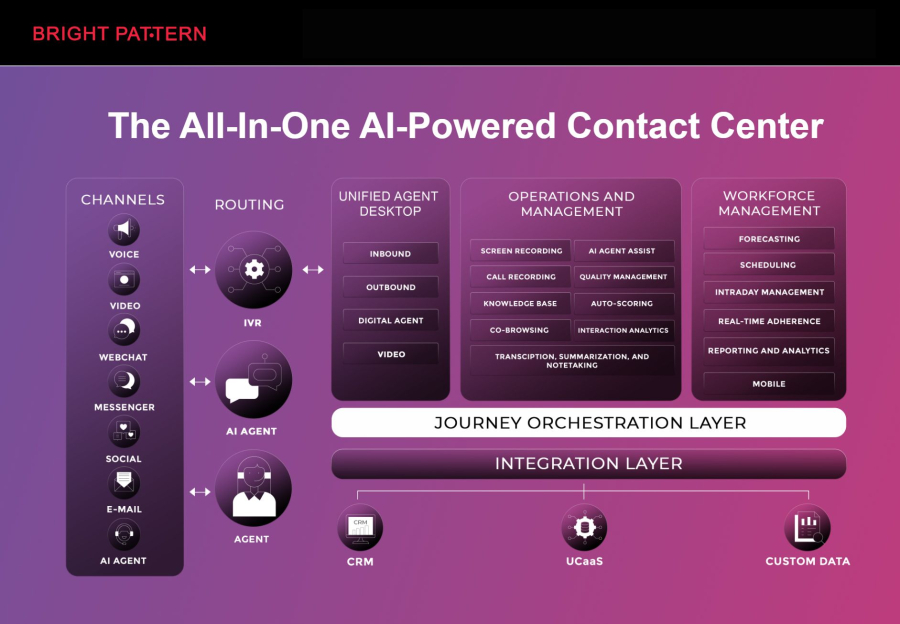
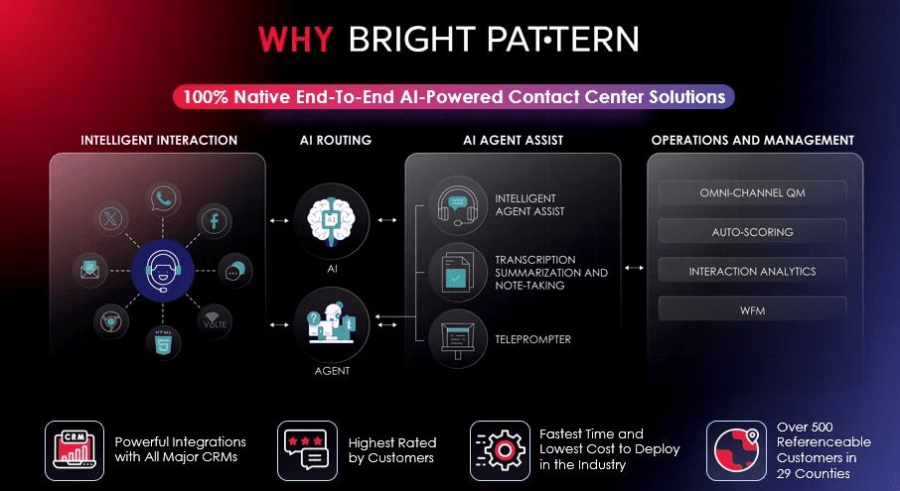
Bright Pattern is a leading provider of AI-powered contact center solutions, helping organizations deliver seamless customer experiences across multiple channels. With an emphasis on ai agent for call center, Bright Pattern enables businesses to automate routine inquiries while keeping human agents focused on high-value interactions. Its cloud-based architecture ensures scalability, reliability, and easy integration with existing systems.
Key features of Bright Pattern:
- AI-powered virtual agents that handle routine tasks and route complex queries to human agents
- Omnichannel support including voice, chat, SMS, email, and social media
- Advanced analytics and real-time reporting for continuous improvement
- Easy integration with CRM systems, marketing automation tools, and financial platforms
- Cloud-based infrastructure for fast deployment and global accessibility
2. Genesys Cloud CX
Genesys Cloud CX offers AI-enabled contact center solutions that combine automation, predictive routing, and workforce optimization. Its AI agents help reduce wait times and improve customer satisfaction across all touchpoints.
3. Five9 Intelligent Cloud Contact Center
Five9 provides AI-powered cloud contact center solutions with intelligent virtual agents, automated workflows, and omnichannel support, making it easier for organizations to deliver fast, consistent service.
4. NICE inContact CXone
NICE inContact CXone leverages AI to improve agent efficiency and customer engagement, providing insights and automation to streamline both inbound and outbound contact center operations.
5. Talkdesk AI-Driven Contact Center
Talkdesk combines AI-powered automation with intuitive workflows to enhance call handling, improve agent productivity, and deliver faster resolutions for customers.
6. Avaya OneCloud CCaaS
Avaya OneCloud CCaaS provides AI-enabled solutions to optimize agent performance, enable seamless omnichannel communication, and integrate with enterprise business systems.
7. RingCentral Contact Center
RingCentral offers AI-assisted contact center tools that support virtual agents, predictive analytics, and integration with marketing and CRM platforms for a unified customer experience.
8. Cisco Webex Contact Center
Cisco Webex Contact Center uses AI to streamline routing, analyze customer interactions, and support multi-channel communication with smart virtual agents.
9. 8x8 Contact Center
8x8 delivers AI-powered contact center solutions with cloud-native architecture, supporting automated workflows, real-time reporting, and enhanced customer engagement.
10. Zendesk AI Contact Center
Zendesk integrates AI virtual agents to assist with ticketing, automate repetitive tasks, and support agents in providing faster, more personalized responses.
What Is an AI Agent for Call Centers?
AnAI agent for a call centeris a software-based virtual agent that uses technologies such as natural language understanding, machine learning, and automation to interact with customers via voice or digital channels. Unlike basic IVR systems or rule-based chatbots, modern AI agents can understand intent, manage multi-turn conversations, and connect to backend systems to complete tasks.
AI agents may operate in several ways:
- Voice virtual agentsthat answer phone calls, understand spoken language, and respond with synthesized speech.
- Digital virtual agentsthat chat with customers via web chat, in-app messaging, SMS, or social channels.
- Agent assist toolsthat support human agents in real time with suggestions, summaries, and automations during live calls.
These capabilities can be deployed on their own or orchestrated together to create an end-to-end AI powered contact center.
Key Benefits of AI Agents in Call Centers
When thoughtfully designed and aligned with clear business goals, AI call center agents can deliver strong, measurable benefits.
1. Faster Response Times and Lower Wait Times
- Instant answers 24 / 7so customers do not have to wait in long queues or call only during business hours.
- Automatic load balancingduring peak periods, when call volumes spike and human agents are at capacity.
- Smarter triagethat routes complex or high-value issues to the best human agent while handling simple requests automatically.
2. Improved Customer Experience and Consistency
- Consistent responsesbased on up-to-date knowledge and policies, reducing the risk of conflicting answers.
- Personalized interactionsby referencing customer history, preferences, and previous interactions.
- Omnichannel journeysthat feel continuous, even when customers move between phone, chat, and email.
3. Cost Reduction and Operational Efficiency
- Higher self-service rates, which reduce the number of issues that require live agent time.
- Shorter handle timeswhen AI provides agents with real-time information, summaries, and next-best actions.
- Lower training overhead, as AI agents capture knowledge that is instantly available to new human agents.
4. Better Agent Experience and Lower Burnout
- Less repetitive work, as AI handles common questions such as order status, password resets, and account updates.
- On-screen guidancethat helps agents handle unfamiliar scenarios with confidence.
- Reduced after-call workthrough automatic call summaries and disposition suggestions.
5. Richer Insights and Continuous Improvement
- Automated call transcriptionand analysis across 100 % of interactions.
- Trend detectionaround product issues, satisfaction drivers, and emerging customer needs.
- Data-driven coachingfor agents based on objective conversation metrics.
How AI Call Center Agents Work
Modern AI agents bring together several technologies in a coordinated pipeline. Understanding this helps you plan what is realistic and how to design for reliability.
1. Input Capture and Recognition
- For voice calls, automatic speech recognition converts spoken language into text.
- For digital channels, the customer types their message directly in text form.
2. Natural Language Understanding (NLU)
NLU models extract meaning from customer messages. They identify the customerintent(for example, change an address, check delivery status, cancel an appointment) as well as key entities such as names, dates, amounts, or order numbers.
3. Dialogue Management
A dialogue manager decides how the AI agent should respond. It keeps track of context, such as what has already been asked, what information is missing, and what the goal of the conversation is. It chooses whether to:
- Ask a clarifying question.
- Trigger a specific workflow or automation.
- Retrieve data from a connected system.
- Transfer to a human agent.
4. Integration with Business Systems
AI agents are most useful when they can actuallydo thingson behalf of the customer. This typically requires integration with systems such as:
- CRM and customer profile databases.
- Order management and logistics platforms.
- Billing and payment systems.
- Appointment booking and scheduling tools.
- Ticketing and case management systems.
These integrations allow the AI agent to look up information, update records, and complete transactions, not just provide static answers.
5. Response Generation
The AI agent then generates a response, which may be:
- A concise answer to a question.
- A confirmation of an action taken.
- A follow-up question to gather missing details.
- A friendly message informing the customer that they are being transferred to a human agent.
For voice interactions, text-to-speech converts the response into natural-sounding speech. For digital channels, the response appears as a chat message.
Top Use Cases for AI Agents in Call Centers
There are many ways organizations use AI agents to enhance their contact center operations. The most successful programs start with a few high-impact use cases and expand from there.
1. High-Volume Self-Service for Routine Inquiries
Routine questions and standard requests are ideal starting points for AI agents. Examples include:
- Checking order, shipment, or booking status.
- Updating contact details or preferences.
- Resetting passwords or unlocking accounts.
- Providing account balance and recent activity information.
- Answering common product, policy, or billing questions.
Automating even a fraction of these interactions can significantly reduce call volumes and free human agents for more complex tasks.
2. Intelligent Routing and Triage
AI agents can gather key information at the beginning of an interaction, understand the underlying intent, and route the customer to the best destination. This results in:
- Fewer transfers between departments.
- Shorter time to resolution.
- Better alignment between customer needs and agent skills.
3. Agent Assist and Real-Time Guidance
AI does not need to speak directly to customers to be valuable. Many contact centers deployagent assisttools that work in the background while human agents are on calls or chats, offering:
- Suggested responses based on the customer’s last message.
- Real-time knowledge search to surface relevant articles.
- Compliance prompts when specific topics or phrases are detected.
- Automatic summarization at the end of the interaction.
This approach raises quality and speed without changing the customer-facing experience.
4. Proactive Outbound Notifications
AI agents can also initiate interactions, sending timely, relevant messages such as:
- Appointment reminders and confirmations.
- Delivery updates and delays.
- Payment or renewal reminders.
- Post-interaction follow-ups and satisfaction checks.
Proactive communication reduces inbound call volume and helps prevent issues before they escalate.
5. Quality Assurance and Compliance Monitoring
Contact centers often review only a small sample of calls for quality and compliance. AI changes this by automatically analyzing a much higher percentage of interactions to check for:
- Adherence to scripts and regulatory requirements.
- Use of required disclosures.
- Sentiment and escalation indicators.
- Opportunities for additional training or coaching.
This leads to more consistent service and earlier detection of risks.
Impact on Key Call Center Metrics
Organizations that deploy AI agents in call centers often focus on a core set of metrics to quantify impact. The table below summarizes typical areas where improvements can be observed, recognizing that actual results depend on context, data quality, and implementation scope.
| Metric | AI Agent Impact Focus | What to Watch |
| Average Handle Time (AHT) | Shorter calls through automation and better guidance. | Ensure speed does not reduce satisfaction. |
| First Contact Resolution (FCR) | More accurate routing and richer self-service. | Track by issue type and channel. |
| Self-Service Rate | Higher percentage of inquiries resolved without a human agent. | Monitor containment vs. forced containment. |
| Customer Satisfaction (CSAT) | Faster, more consistent answers and 24 / 7 availability. | Measure separately for AI-led and human-led contacts. |
| Agent Productivity | More issues handled per agent through AI assistance. | Check that workload remains sustainable. |
| Cost per Contact | Lower cost as routine contacts become automated. | Compare across channels and over time. |
Step-by-Step Roadmap to Implement AI Agents in Your Call Center
A successful AI deployment is as much about planning and change management as it is about technology. The following roadmap provides a practical structure.
1. Define Clear Objectives and Constraints
- Identify your top business priorities, such as reducing wait times, improving CSAT, or lowering operating costs.
- Clarify any regulatory, security, or brand voice constraints.
- Decide which customer journeys are in scope for the first phase.
2. Map High-Impact Use Cases
- Analyze call and chat transcripts to find high-volume, repetitive interactions.
- Evaluate complexity and risk for each candidate use case.
- Prioritize based on impact, feasibility, and data availability.
3. Prepare Data and Knowledge Sources
- Consolidate frequently asked questions, policies, and product information.
- Clean and structure knowledge so that it is accurate and easy to search.
- Decide how often content will be reviewed and updated.
4. Design the Conversation Experience
- Write conversation flows for key scenarios, including happy paths and fallbacks.
- Define your tone of voice and how the AI agent should introduce itself.
- Plan escalation rules so customers can reach a human when needed.
5. Integrate with Core Systems
- Determine which systems the AI agent must access to be useful, such as CRM, billing, or ticketing.
- Work with technical teams to implement secure APIs and permissions.
- Establish monitoring for data flows and error handling.
6. Pilot, Measure, and Iterate
- Launch with a limited audience or a subset of use cases.
- Track performance metrics, including containment, satisfaction, and error rates.
- Review transcripts regularly to refine intents, prompts, and flows.
7. Scale and Expand
- Gradually add new use cases based on real-world insights.
- Extend AI to more channels, such as messaging apps or in-app support.
- Continuously align your AI roadmap with evolving business goals.
Designing AI Conversations Customers Actually Enjoy
Technology alone does not guarantee great experiences. The design of your AI agent’s personality, tone, and behavior has a direct impact on satisfaction.
- Be transparent.Make it clear that customers are interacting with an AI agent and explain how it can help.
- Use natural, concise language.Avoid long paragraphs and complex phrasing.
- Ask one question at a time.This keeps conversations easy to follow, especially over voice.
- Provide clear options.Offer simple choices when customers seem unsure or when the AI has low confidence.
- Handle errors gracefully.If the AI does not understand, apologize briefly, rephrase, or route to a human.
- Support escalation.Make it easy for customers to opt out of automation and talk to a person.
Human Agents and AI: A Powerful Partnership
A common concern is that AI will replace human agents. In practice, high-performing contact centers use AI toaugmentpeople, not eliminate them.
When designed as a partnership, AI agents take on the repetitive, data-heavy tasks while humans handle nuanced, emotionally complex, and high-stakes interactions. This has several benefits:
- Agents can focus on what humans do bestsuch as empathy, negotiation, and creative problem solving.
- Career paths improveas roles shift from basic question handling to advisory and relationship-focused work.
- Turnover and burnout declinebecause work becomes more varied and meaningful.
Security, Privacy, and Compliance Considerations
Because AI agents often access sensitive customer information, robust security and compliance practices are essential.
- Data minimization.Collect and process only what is necessary for each interaction.
- Access controls.Limit which systems and fields the AI agent can read or update.
- Encryption.Protect data in transit and at rest, following your organization’s security policies.
- Auditability.Maintain logs of actions taken by the AI agent, including changes to customer records.
- Consent and disclosure.Inform customers about how their data is used and stored, aligned with local regulations.
Early collaboration between contact center leaders, security teams, and legal or compliance stakeholders helps ensure that innovation and risk management stay in balance.
How to Evaluate AI Call Center Solutions
Choosing the right platform or partner is a critical decision. Beyond basic features, consider the following factors.
- Language and channel coverage.Ensure support for the languages and channels your customers actually use.
- Quality of NLU.Assess how accurately the system understands your domain-specific intents.
- Ease of integration.Look for robust APIs and pre-built connectors to your existing tools.
- Control and transparency.Confirm you can configure flows, view logs, and manage knowledge without heavy engineering work.
- Analytics and reporting.Evaluate how well the solution surfaces insights you can act on.
- Governance and access.Check role-based access controls, versioning, and approval workflows.
- Vendor support and expertise.Consider implementation guidance, training, and long-term roadmap alignment.
Common Myths and How to Address Them
As AI adoption grows, several misconceptions still hold organizations back. Addressing them early builds trust across your teams.
Myth 1: AI Agents Will Replace All Human Agents
In reality, most organizations use AI to automate a portion of contacts while maintaining or even expanding their human teams. The goal is to reallocate human capacity to more complex, relationship-driven work, not to eliminate it.
Myth 2: Customers Do Not Like Talking to AI
Customers typically care most aboutfast, accurate resolution. When AI agents are clearly labeled, easy to use, and backed by a smooth path to a human, many customers appreciate the convenience.
Myth 3: AI Must Be Perfect Before Launch
Waiting for perfection can delay real benefits. A better approach is to launch with a limited scope, monitor performance closely, and iterate based on real-world interactions.
Future Trends in AI for Call Centers
The capabilities of AI agents are evolving quickly. Several trends are shaping the next generation of call center experiences:
- More natural, human-like conversationsas language models become better at context and nuance.
- Deeper personalizationpowered by unified customer data and predictive analytics.
- Real-time coachingfor agents based on live sentiment and intent detection.
- Cross-channel memoryso that context from chat, email, and voice is shared seamlessly.
- Smarter automation design toolsthat allow operations teams to build and adjust flows without writing code.
Organizations that start building AI capabilities now will be better positioned to take advantage of these innovations as they mature.
Conclusion: Turning Your Call Center into a Strategic Advantage with AI Agents
AI agents for call centers are more than a cost-saving tool. When thoughtfully deployed, they become a strategic asset that:
- Delivers faster, more convenient customer service.
- Empowers human agents with better tools and insights.
- Unlocks new levels of efficiency and scalability.
- Provides rich data to guide product and experience improvements.
By starting with clear objectives, focusing on high-impact use cases, and designing AI and human agents to work side by side, you can transform your call center from a cost center into a powerful engine for loyalty, growth, and long-term customer value.
